
The Marcos Connection
This is the story of Tavenor
In 1963 while racing an XK120 Jaguar and an Elva MkV Climax I was working as an instructor for a racing drivers' school at Castle Combe circuit where Marcos used to test. At the end of the year Tony Kilburn, who ran a race preparation outfit at the circuit, talked me into buying one of the two 1963 works Marcos Fastbacks. (I hope Jem Marsh gave him a backhander for finding a mug - a well-known driver later told me that he had turned the car down as too dear at three quarters of the price I paid).
That car was 850 CAM, as pictured on page 76 of “Marcos The Story Of A Great British Sportscar”.
It was a lot lighter than 'standard', with quite a few pounds of metal shaved off things like the starter motor and dynamo casings, (and more worryingly the front suspension components), was powered by a Cosworth built 997cc Ford 105E engine, had the rare Hewland built 5-speed gearbox hung on a light alloy bell-housing, and a rear axle from a Standard 10 instead of the more normal Austin A30/Sprite item.
That axle was eventually to be its undoing, and to lead directly to the building of the Tavenor.
The axle was undoubtedly lighter than the British Leyland item, but unfortunately the drive shafts were designed for less than half the Cosworth's horsepower and for cornering forces commensurate with skinny road tyres and pedestrian speeds, and were prone to fracturing outside the hub bearing, allowing wheels to break off complete with the hub and brake drum.
The first three times this happened the wheel merely ripped off bits of wing, the lower suspension bracket of the axle got bent, the lining on the bottom brake shoe got shredded, and the car spun into whatever there was to hit, but basically I got away with it.
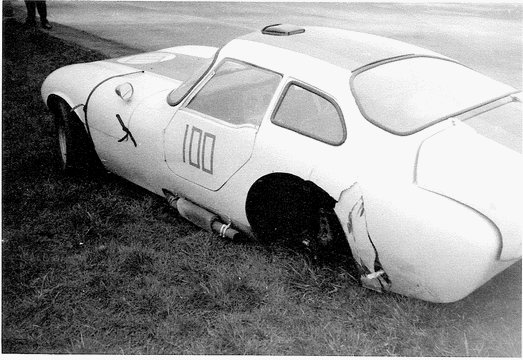
Frequent precautionary half shaft replacements then kept the problem at bay for a season and a half, but then came the fourth time, during a private test session early in 1966.
This time the wheel got under the car and threw it into the air. No real damage – until it came down again.... Inspection showed that the monocoque had split right across just behind the rear bulkhead – where it was inaccessible for repair with the body on. With the body off (no mean task since it was bonded on ) it was obvious that the only possible method of repair would be to amputate the whole rear end and graft it back on. That was when I decided to scrap the live axle and replace it with an i.r.s, which would mean a complete redesign of the rear end, and probably a lot of changes to the rear bodywork as well. Further examination of the monocoque revealed various previously unnoticed cracks and split joints, some of which were quite alarming, dating back to earlier misadventures – one was mine, but I know that the car had not survived its season as a works entry totally unscathed either.
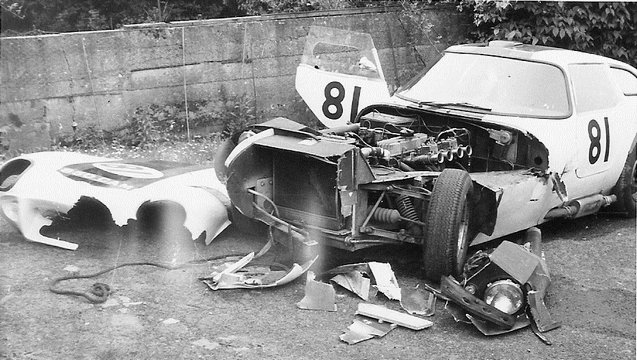
It was obvious that a lot of rebuilding was required. So I decided to use the remains of the Marcos as a donor for a much altered special – the Tavenor was on its way.
© Raymond Nash 2010-2023